
1723534562.png)

CAT Syllabus 2026 PDF: Complete Section-Wise Syllabus for VARC/DILR/QA
September 28, 2026
The CAT syllabus 2026 covers three sections: Verbal Ability and Reading Comprehension (VARC, 24 questions), Data Interpretation and Logical Reasoning (DILR, 22 questions) and Quantitative Ability (QA, 22 questions). IIMs don't publish a chapter-wise syllabus, but past papers show QA follows Class 8–10 maths, VARC is mostly reading comprehension, and DILR tests sets and puzzles.
| Section | Questions | Time | Key Topics |
|---|---|---|---|
| VARC | 24 | 40 min | Reading Comprehension, Para Jumbles, Para Summary, Odd Sentence Out |
| DILR | 22 | 40 min | Tables, Charts, Caselets, Arrangements, Games & Tournaments, Scheduling |
| QA | 22 | 40 min | Arithmetic, Algebra, Geometry, Number System, Modern Maths |
| Total | 68 | 120 min | +3 for correct answers, −1 for wrong MCQs, no negative marking for TITA |
CAT 2026 is on 29 November, conducted by IIM Indore, about nine weeks away. That's not enough time to study every topic equally, and you don't need to. In recent papers, reading comprehension made up about two-thirds of VARC, and Arithmetic and Algebra together made up more than half of QA. Get those right first, then practise DILR sets under time pressure, because DILR is where most percentiles are won or lost. Below you'll find the full topic list, topic-wise weightage from recent papers and a free syllabus PDF
This article covers the complete CAT syllabus 2026, section-wise topics, important chapters, expected weightage, preparation tips, exam pattern and a practical study plan.
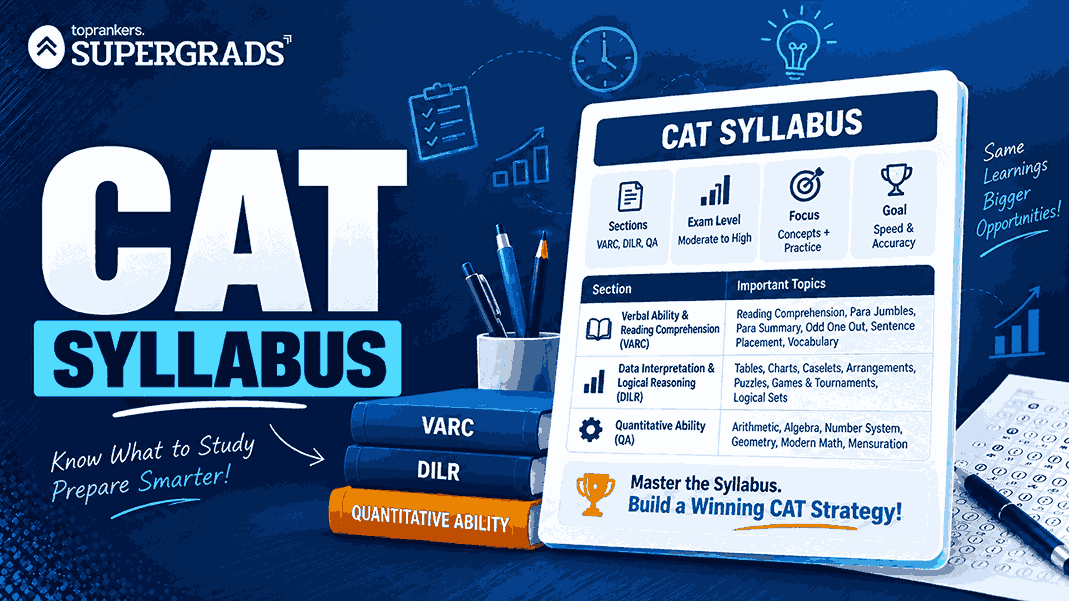
CAT Exam Syllabus 2026: Quick Overview
Cat syllabus 2026 is broadly divided into three sections. Each section tests a different skill, so the preparation strategy should also be different.
As per CAT Exam Pattern, the paper has 68 questions and is conducted for 120 minutes. The paper includes MCQs and non-MCQs, commonly known as TITA questions. Correct answers carry 3 marks, while an incorrect MCQ generally attracts a 1 mark penalty.
MBA cat syllabus is designed to check aptitude rather than advanced subject knowledge. You need to understand concepts, apply them correctly and make quick decisions while solving questions.
| Section | Questions | Time | Major Topics |
|---|---|---|---|
| VARC | 24 | 40 Minutes | Reading Cobmprehension, Para Jumbles, Para Summary, Odd One Out |
| DILR | 22 | 40 Minutes | Data Interpretation, Puzzles, Arrangements, Logical Reasoning |
| QA | 22 | 40 Minutes | Arithmetic, Algebra, Geometry, Number System |
Download Subject-wise CAT 2026 Syllabus PDFs
| Subject wise Syllabus | PDF Links |
|---|---|
| CAT QA Syllabus | |
| CAT DILR Syllabus | |
| CAT VARC Syllabus |
CAT Syllabus 2026: Section-Wise Topics
The syllabus of CAT Exam can look lengthy when all the topics are listed together. However, it becomes easier to manage when divided into VARC, DILR and QA.
Candidates preparing according to the cat syllabus 2026 should first understand the basic topics in each section and then identify the chapters where they need more practice.
CAT VARC Syllabus 2026
Verbal Ability and Reading Comprehension is the first section of CAT syllabus. It mainly tests your reading ability, understanding of arguments and ability to arrange or summarise information.
Reading Comprehension has traditionally formed the larger part of this section. Verbal Ability includes questions based on paragraph structure and logical flow.
VARC Important Topics
- Reading Comprehension
- Para Jumbles
- Para Summary
- Odd Sentence Out
- Para Completion
Reading Comprehension
Reading Comprehension is one of the most important parts of CAT syllabus. Passages can be based on subjects such as history, science, economics, philosophy, technology, society and culture.
You are not expected to be an expert in these subjects. The questions are generally designed to test how well you understand the passage.
Questions may ask you to identify:
- The main idea
- The author's argument
- The tone of the passage
- An inference
- The purpose of a statement
- The meaning of a phrase
- The relationship between ideas
CAT DILR Syllabus 2026
Data Interpretation and Logical Reasoning form the second section of CAT syllabus. This section can feel unpredictable because the difficulty of the paper often depends on the sets that appear.
The DILR section contains 22 questions in the current pattern. These questions are generally presented through sets rather than as completely independent questions.
Important DILR Topics: The major areas include:
Data Interpretation
- Tables
- Bar Graphs
- Line Graphs
- Pie Charts
- Caselets
- Data Comparison
- Missing Data
- Charts
- Data-based puzzles
Logical Reasoning
- Seating Arrangement
- Linear Arrangement
- Circular Arrangement
- Distribution
- Selection
- Scheduling
- Ranking
- Games and Tournaments
- Team Formation
- Networks
- Routes and Directions
- Venn Diagrams
- Logical Puzzles
CAT syllabus for DILR does not require you to memorise a large number of formulas. Instead, you need to learn how to read information, organise it and find relationships between different conditions.
Why DILR Needs Regular Practice
DILR is not a section that can be mastered in a few days. You need to solve different types of sets regularly.
A set may initially appear difficult because of the amount of information given. However, once you represent the information correctly, the questions may become much easier.
This is why CAT previous year papers are useful for understanding the mba cat syllabus. They show you how the concepts are actually tested.
Set Selection in DILR
You do not have to solve every set in the exam.
One of the most useful DILR skills is knowing which set to attempt first. During the exam, spend a few minutes scanning the sets and identify those that look manageable.
Prefer sets where:
- The information is easy to understand.
- The conditions are clearly stated.
- You can find a starting point.
- The calculations are manageable.
- Multiple questions can be solved from the same information.
If a set is taking too long just to understand, move to another one.
CAT QA Syllabus 2026
Quantitative Ability is the third section of CAT exam syllabus. It tests mathematical concepts and your ability to apply them efficiently.
Most QA concepts are based on school-level mathematics. However, CAT questions are often designed in a way that requires more thinking than direct formula application.
Important QA Topics: The QA section of cat syllabus is divided into five areas:
Arithmetic
- Percentages
- Profit and Loss
- Simple Interest
- Compound Interest
- Ratio and Proportion
- Averages
- Mixtures and Alligation
- Time, Speed and Distance
- Time and Work
- Pipes and Cisterns
Algebra
- Linear Equations
- Quadratic Equations
- Inequalities
- Functions
- Progressions
- Algebraic Expressions
- Logarithms
- Surds and Indices
- Special Equations
Geometry and Mensuration
- Lines and Angles
- Triangles
- Circles
- Quadrilaterals
- Polygons
- Coordinate Geometry
- Area
- Volume
- Mensuration
Number System
- Number Properties
- Factors and Multiples
- HCF and LCM
- Divisibility
- Remainders
- Prime Numbers
- Units Digit
- Last Two Digits
- Base System
Modern Mathematics
- Set Theory
- Venn Diagrams
- Permutation and Combination
- Probability
Arithmetic and Algebra are particularly important areas to cover early. However, candidates should not completely ignore other topics because the exact mix of questions can change.
CAT 2026 Topic Priority: What to Study First (Based on Recent Trends)
Quick note: CAT doesn’t have an official topic-wise CAT exam syllabus PDF. The priority below is compiled from recent CAT patterns and topic-weightage trends so you can focus on the most recurring + high-return areas first.
1) VARC Priority (24 Questions): RC is the game
| Topic | Typical Weightage | What to Practise |
|---|---|---|
| Reading Comprehension (RC) | ~60–70% | Inference, tone, central idea, paragraph function, vocabulary-in-context |
| Para Summary | ~10–15% | Main idea + elimination-based options |
| Para Completion / Odd Sentence Out | ~5–10% | Logical flow + theme detection |
2) DILR Priority (22 Questions): Sets decide your percentile
| Topic | Typical Weightage | What to Practise |
|---|---|---|
| Puzzles & Arrangements | ~50–60% | Linear/circular/grid sets, distribution, ranking, hybrid logic |
| Tables & Charts DI | ~40–50% | Tabular DI, bar/line/pie, mixed chart sets, caselets |
| Games & Tournaments | ~10–20% | Round-robin/knockout, points table logic |
3) QA Priority (22 Questions): Arithmetic + Algebra first
| Topic | Typical Weightage | What to Practise |
|---|---|---|
| Arithmetic | ~35–50% | Percentages, ratios, TSD, time & work, averages, P&L, SI/CI, mixtures |
| Algebra | ~25–35% | Equations, inequalities, functions, sequences & series, logs |
| Geometry & Mensuration | ~10–15% | Triangles, circles, 2D/3D mensuration, coordinate basics |
| Number System + Modern Maths | ~5–10% each | Divisibility/remainders + P&C/probability/sets basics |
How to use this priority (simple rule)
- First 60% of prep time → RC + DILR sets + Arithmetic/Algebra (highest repeat zones).
- Next 30% → Geometry + DI chart variety + VA (summary/completion/odd one).
- Last 10% → low-frequency topics (but keep them warm with weekly mixed practice).
Why this matters: CAT moved back to 68 questions in recent years with DILR at 22 questions, so set-selection and high-yield topic mastery have become even more important.
CAT Syllabus 2026 Topic-Wise Weightage
There is no permanent chapter-wise weightage for CAT exam syllabus. The number of questions from a topic can change from one year or slot to another.
Still, CAT Previous Year Papers give candidates a useful idea about the areas that deserve more attention.
| Section | Important Areas |
|---|---|
| VARC | Reading Comprehension, Para Summary, Para Jumbles |
| DILR | Arrangements, Puzzles, Tables, Graphs, Caselets |
| QA | Arithmetic, Algebra, Geometry, Number System |
In recent trends, Reading Comprehension has made up the largest share of VARC, while Arithmetic and Algebra together account for a major portion of QA. DILR can have a mix of Logical Reasoning and Data Interpretation sets.
Candidates should use these trends for prioritisation rather than treating them as fixed rules.
How to Prepare CAT Syllabus 2026?
CAT syllabus becomes much easier when you divide preparation into clear stages.
Step 1: Understand the Complete Syllabus
Before starting CAT Preparation, go through the cat syllabus 2026 and divide the topics into three categories:
- Strong topics
- Topics that need practice
- Topics that are completely new
This will help you decide where to spend more time.
Step 2: Build Your Basics
Start with the fundamentals.
For QA, understand the basic formulas and concepts.
For VARC, build a reading habit and start solving easy RCs.
For DILR, begin with simple sets and learn how to represent information.
Step 3: Practise Questions
Once the concepts are clear, solve questions regularly.
Do not focus only on the number of questions you solve. Check:
- Why did you make the mistake?
- Did you misunderstand the question?
- Was your method too long?
- Did you spend too much time?
- Could you have skipped the question?
Step 4: Solve Previous Year Questions
Previous year CAT questions are one of the best ways to understand the actual level of the CAT syllabus.
They help you identify recurring concepts and understand how familiar topics are presented in different ways.
Step 5: Start Taking Mocks
Mocks should become a regular part of preparation once you have covered a reasonable portion of the syllabus.
Initially, focus on accuracy. Later, work on speed, selection and time management.
Important Topics in CAT Syllabus 2026
If you have limited preparation time, start with the topics that have appeared frequently in previous CAT papers.
VARC
| Reading Comprehension | Para Summary |
| Para Jumbles | Old Sentence |
| Para Completion | - |
DILR
| Tables | Seating Arrangement | Scheduling |
| Graphs | Distribution | Games and Tournaments |
| Caselets | Selection | Networds |
QA
| Percentages | Time and Work | Number System |
| Ratio and Proportion | Time, Speed and Distance | Probability |
| Averages | Algebra | Permutation & Combination |
| Profit and Loss | Geometry | - |
These should form the core of your preparation, but the complete CAT Exam Syllabus should still be covered.
Common Mistakes While Preparing CAT 2026
Knowing the mba cat syllabus is only the first step. Many students lose valuable preparation time because of avoidable mistakes.
- Studying Without a Plan: Do not randomly pick chapters every day. Divide CAT syllabus into weekly targets.
- Ignoring Weak Areas: It is easy to keep studying your favourite section. But a strong overall score requires balanced preparation.
- Taking Mocks Too Early: Mocks are important but taking them without knowing the basics may not give you useful insights.
- Not Analysing Mocks: Your mock score is not the only thing that matters. The real benefit comes from understanding why you made mistakes.
- Trying to Solve Everything: CAT rewards smart decision-making. Spending five minutes on one difficult question can cost you several easier questions.
- Ignoring Previous Year Papers: PYQs give you a realistic understanding of the CAT exam syllabus and help you identify how concepts are tested.
CAT Syllabus and Previous Year Questions
CAT previous year questions are very important part of your exam preparation. They show you how the CAT exam syllabus is converted into actual exam questions.
PYQs help you understand:
- Question difficulty
- Common concepts
- Question framing
- Calculation requirements
- Answer choices
- Time required
Try solving topic-wise PYQs after completing individual chapters. Later, attempt complete papers under timed conditions.
CAT 2026 Preparation Tips
While preparing for CAT Exam, candidates are suggested to keep these points in mind.
- First understand the syllabus & then start your preparation.
- Strong your basics first.
- Practise regular on daily basis.
- Read regularly for VARC.
- Solve DILR sets consistently.
- Give extra attention to Arithmetic and Algebra.
- Revise formulas regularly.
- Practice CAT previous year questions
- Take sectional tests.
- Analyse every mock.
- Maintain an error log.
- Improve question selection.
- Do not spend too long on one question.
- Revise weak topics multiple times.
The goal is not just to finish CAT exam syllabus. You should reach a point where you can identify the right approach quickly and decide whether a question is worth attempting.
CAT Exam Pattern 2026
Knowing the CAT Exam Pattern along with CAT syllabus is important because CAT is not simply a test of knowledge. It is also a test of speed and decision-making.
| Particular | Details |
|---|---|
| Exam Mode | Computer-Based Test |
| Total Questions | 68 |
| Total Duration | 120 Minutes |
| VARC | 24 Questions |
| DILR | 22 Questions |
| QA | 22 Questions |
| Time per Section | 40 Minutes |
| Correct Answer | +3 Marks |
| Wrong MCQ | -1 Mark |
| TITA Wrong Answer | No Negative Marking |
Candidates cannot freely move between the three sections. Once the 40-minute time limit for a section ends, the test moves forward.
This makes time management an important part of preparing for CAT exam syllabus.
Conclusion
The CAT exam syllabus becomes easier to manage when you divide it into three sections, identify your strengths and weaknesses, and prepare topic by topic. Use CAT previous year papers, sectional tests, and mock tests to track your progress, improve accuracy, and maintain an error log for repeated mistakes. Whether you’re starting out or revising for CAT 2026, use a reliable CAT syllabus PDF as a checklist and focus on consistent practice, speed, and question selection.

Smart Prep for CAT: Join Our Free Demo Class
Fill your details
Frequently Asked Questions
Are there any changes in the CAT syllabus for non-engineering students?

What is the level of difficulty of the CAT syllabus?
How is the Data Interpretation and Logical Reasoning (DILR) section structured in the CAT exam?
Which books are recommended for preparing for the CAT syllabus?
What topics are covered under the Quantitative Aptitude (QA) section?
How can I prepare for the CAT syllabus?
Is the CAT syllabus fixed or does it change every year?
What subjects are included in the CAT syllabus?

Lalita Vishwakarma
Content Writer
SHARE